The Essence of Bertha, Wrapped in a Claude Code Skill
Bertha was a full marketing operating system — nineteen-odd microservices running for real clients. Most small businesses will never need nineteen microservices. What they need is her judgement, without the infrastructure. So I distilled it — five disciplines, seventeen reference engines, one operating doctrine — into a single Claude Code skill you can install in the time it takes to make a cup of tea. Strategy by subtraction, cohorts you didn't assume, hooks that couldn't belong to your competitor, media budgets with unit economics behind them, and a red-team panel that tries to break the plan before the market does it for free. A fragment, not the whole star — but a fragment carrying the complete pattern.
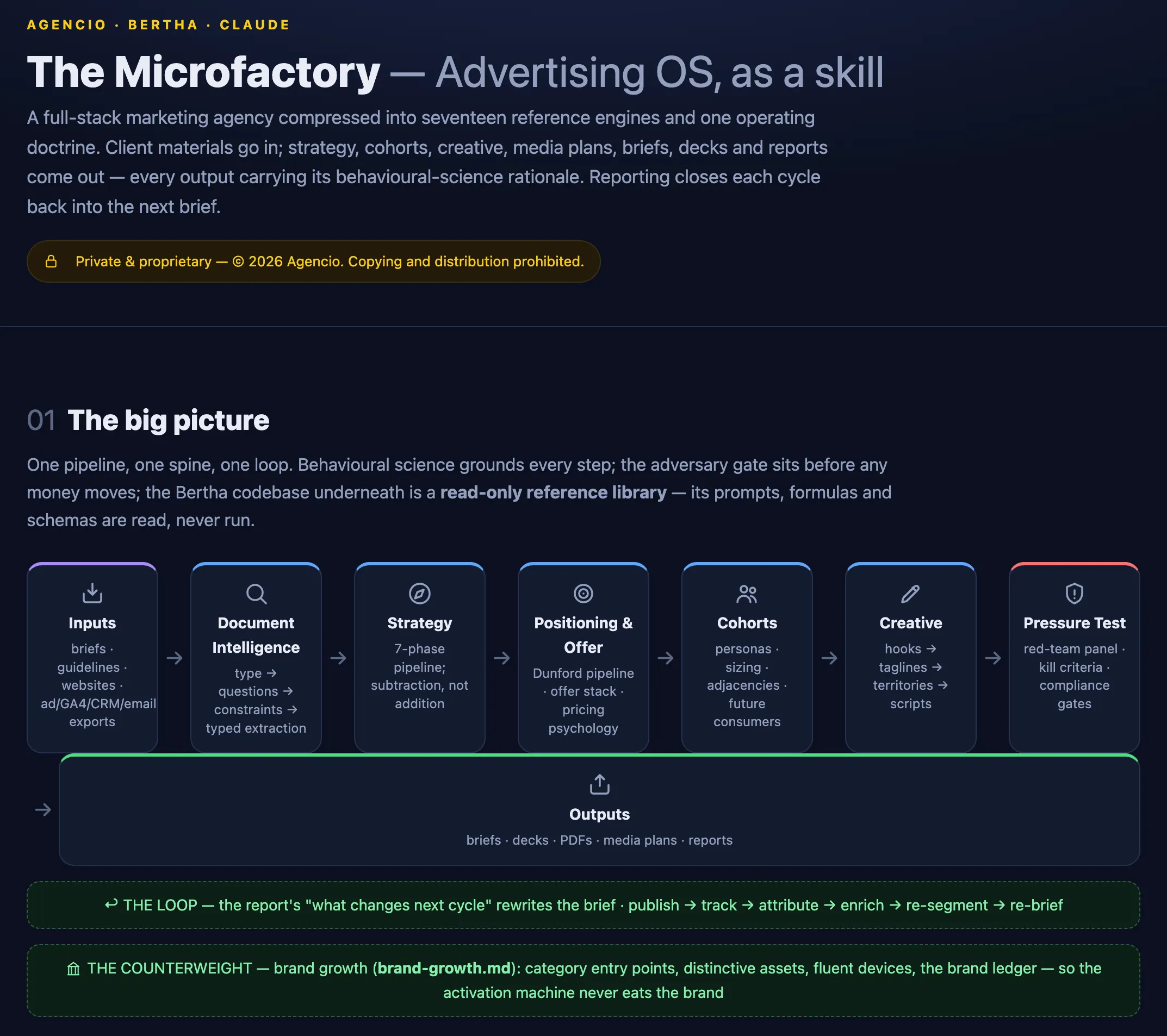
A full marketing operating system, distilled into something that installs in the time it takes to make a cup of tea.
There is, if you will permit me a moment of throat-clearing before we get to the useful bit, something rather wonderful about distillation. Not the whisky kind, though I shan’t pretend I’m above that either, but the general principle: that a vast, sprawling, magnificently complicated system can be reduced — carefully, not carelessly — down to its working essence, and that essence can then be poured into a much smaller vessel without losing the thing that made the original worth having in the first place. Brandy survives the still. So, it turns out, does a marketing department.
Bertha, for those meeting her for the first time, was — is, in the sense that a retired engine still has all its parts, even switched off — a full marketing operating system. Nineteen-odd microservices and a frontend, running for real clients, doing the whole unglamorous magnificent business of an agency: taking in a brief, working out who the audience actually is as opposed to who the deck says they are, building the positioning, writing the hooks, planning the media spend, watching the numbers come back, and closing the loop by rewriting the next brief with what was learned. A proper system, in other words — the kind of thing that, viewed from a sufficient height, has the same appeal as a well-run ecosystem or a functioning galaxy: many small, disagreeing parts, coaxed into a single coherent motion.
Most small businesses will never need, want, or frankly be able to afford nineteen microservices. What they need is Bertha’s judgement — the accumulated sense of what works, why it works, and which options were considered and correctly thrown in the bin — without the infrastructure. That is what this is: not Bertha herself, but her essence, distilled into a single Claude Code skill you can install in about the time it takes to make a cup of tea. A fragment of the whole, certainly. But a fragment carrying the complete pattern, the way a single crystal carries the geometry of the entire structure it grew from.
What you’re actually getting
Feed it your documents — briefs, brand guidelines, a website, exports from your ad platforms or CRM — and it works the problem the way the five disciplines inside a real agency would: strategist, creative, media planner, behavioural scientist, and data engineer, arguing with each other in the way that good colleagues do, until something coherent falls out the other side.
It will build you a strategy by subtraction — showing you not just what to do, but the adjacent, tempting, wrong things it declined to do on your behalf, and why. It will work out who your customers actually are, not who you assumed they were. It will write hooks and taglines and refuse, as a matter of principle, to hand you anything so generic it could belong to your competitor. It will plan a media budget with actual unit economics behind it rather than vibes. And — this is the part I’m rather fond of — before anything ships or spends a penny, it runs the whole plan through an adversarial pressure test. A red-team panel whose entire job is to try to break your idea before the market does it for free. Every generator inside it has a judge scoring its own output before you ever see it; nothing arrives as a first draft dressed up as a final one.
It is, in short, an attempt to hand small businesses the insight — into marketing, media, and strategy — that has historically required a retainer with several zeroes on it. Not the production, not the media buying itself; those still happen on whatever platforms you already use. What this hands you is the thinking that normally sits behind a closed door in a conference room you weren’t invited to.
How to actually use the thing
Splendidly simple, as these things go.
1. Install it once. It arrives as a packaged skill folder with an installer for Mac, Linux and Windows — the script does the mkdir-ing and unzipping, and drops it into ~/.claude/skills/. That is the entirety of the setup. There is no service to provision, no key to paste, nothing to keep running.
2. Ask it something. In plain English. No special incantations required — mention marketing, a campaign, a brand problem, and it tends to notice on its own.
3. Feed it the real thing, not your summary of it. Original documents, not paraphrases. The extraction engine is built to mine the verbatim specifics — your summary, however well-intentioned, has already thrown away exactly the details that make the output sound like you and not like everyone else in your category.
4. Let it argue with you. It will ask questions. Answer them properly. Then, before anything goes near real money, say the magic words: “Poke holes in this plan before we spend.”
5. Close the loop. Bring the results back afterwards. A report that doesn’t change the next brief is just a receipt. The whole point of the exercise — the reason Bertha was built as a loop and not a straight line — is that the system gets a little smarter about your business every cycle.
What that sounds like, concretely
| You say | It runs | You get back |
|---|---|---|
| ”Audit acme-widgets.com — where’s the front door leaking?” | Asset & website audit | Scorecard, friction ledger, a 30/60/90 plan |
| ”We have £3k a month — where should it go?” | Unit economics + media doctrine | Real target CPA, a proper media plan |
| ”Poke holes in this before we spend” | Adversary mode | Red-team table, kill criteria, a verdict |
| ”Name the product” | Five-pass naming sprint | A shortlist that survived a rejection gauntlet |
| ”Here’s last month’s numbers — what now?” | Reporting + CRM loop | A readout with actions, and next cycle’s re-brief |
A small note on proportion
It’s worth being honest about scale, in the way any decent scientist would insist on before letting the metaphor run away with itself: this is a fragment, not the whole star. Bertha, at full strength, is a running system with real infrastructure behind it. What ships here is her methodology — the formulas, the judge rubrics, the platform mechanics — read as reference, never called as a service. For most small businesses, that fragment is, quite genuinely, more marketing thinking than they’ve had access to before. It won’t run your ad accounts for you. It will tell you, with the receipts, what to say to them and why.
Get it
The skill itself — Bertha Featherweight — is private and proprietary, and available on request. If you want it pointed at your business, ask me for it and I’ll send the package and the installer.
The architecture, though, is worth reading whether or not you ever install anything. It sets out the whole shape: one pipeline, one spine, one loop; the five minds and why they are coupled; the document hub where every chart pairs with the action it implies; and the mode router that turns a plain-English question into the engine that answers it.
The long version of how Bertha was built — and the honest account of why she stalled on resourcing rather than merit — is in Understanding Marketing. Private & proprietary — © 2026 Agencio.