Twenty Years On: Why Social Media Needs a Reboot
Somewhere under the infinite scroll and the fifteen flavours of algorithmic feed there is a beautifully simple idea — people, telling each other things. Everything else is barnacle. A physicist's look at the attention economy as an entropy pump, what each of the five great platforms taught us on the way down, the sixteen billion dollars Meta's own internal documents attribute to scam ads, and the design brief for a race to the top — sell something other than attention, let feeds end, make advertising ask permission. None of it is a law of nature. The reboot isn't a dream; it's a to-do list.
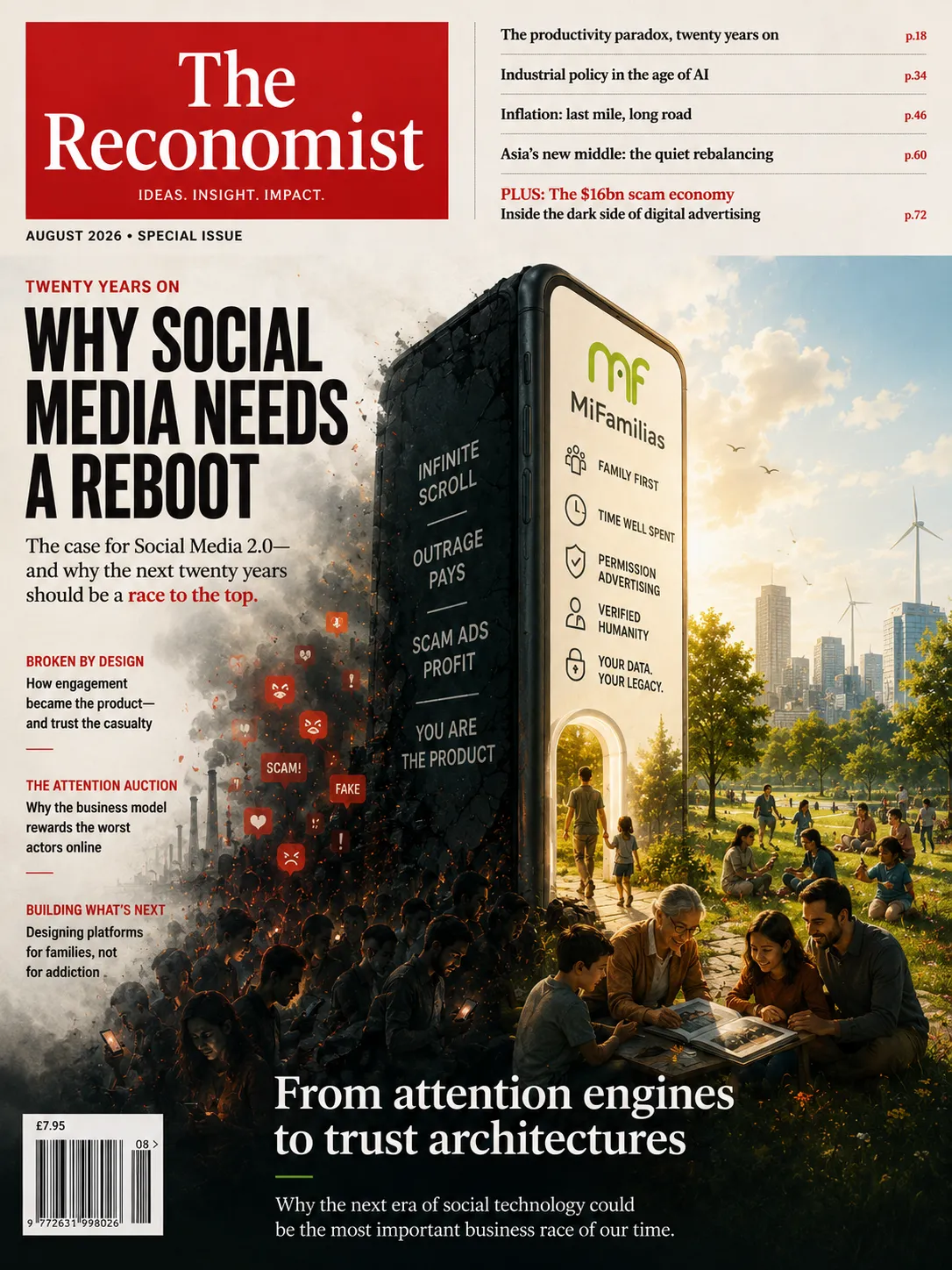
The case for Social Media 2.0 — and why the next twenty years should be a race to the top.
There is a moment, familiar to anyone who has ever dismantled an old machine, when you find the original design underneath all the accretions — the elegant thing it was meant to be before two decades of bolted-on afterthoughts. I had that feeling recently, thinking about social media. Somewhere under the infinite scroll and the engagement metrics and the fifteen flavours of algorithmic feed, there is a beautifully simple idea: people, telling each other things. That’s it. That’s the machine. Everything else is barnacle.
We are now twenty years or so into the great experiment — MySpace and Facebook in the mid-2000s, then the smartphone, then the deluge — and I think it’s time we were honest with ourselves about the results. Not hysterical. Not nostalgic. Honest. Because the experiment has produced findings, the way all good experiments do, and the findings are in. We simply haven’t acted on them yet.
The physics of the thing
Let me put on my physicist’s hat for a moment, because I find it clarifies matters wonderfully.
Any system left to itself tends towards disorder. Entropy increases; it’s not a moral judgement, it’s just what happens when nothing is spending energy to maintain structure. And an attention marketplace, left to optimise for itself, behaves exactly like this. Signal is expensive to produce — a thoughtful post, an honest photograph, a genuinely useful advertisement all cost effort. Noise is nearly free. So unless the system is actively engineered to privilege signal, noise wins. Not because anyone is wicked, but because the maths says so.
Now here’s the part that took me embarrassingly long to see clearly. The engagement-optimised feed doesn’t merely fail to resist this entropy — it accelerates it. An algorithm tuned to maximise time-on-app is agnostic about what holds your attention. Outrage holds attention. Envy holds attention. A scam promising to double your money holds attention magnificently. The recommender system is, in the most literal sense, an entropy pump: it seeks out whatever makes you dwell, and the cheapest reliable sources of dwelling are the worst things we make.
Twenty years of platform history is, viewed this way, a single controlled demonstration of what happens when you point an optimiser at the wrong objective function and give it two billion test subjects.
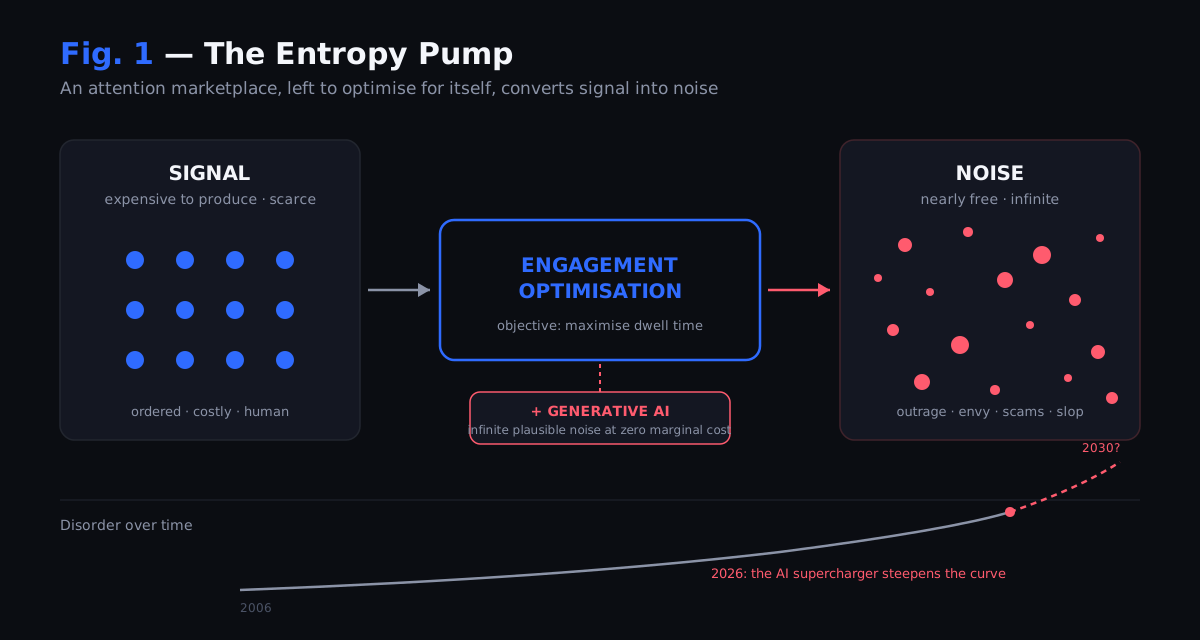
Signal is expensive and scarce; noise is nearly free. An engagement optimiser pumps attention from one to the other — and generative AI has just been bolted on as a supercharger.
What each platform taught us
I don’t say any of this with contempt. Each of the great platforms began with something true, and each one’s decay teaches a distinct lesson — and we should be grateful for the tuition, however eye-watering the fees.
Facebook taught us that connection curdles when it becomes broadcast. It began as something almost sweet — a campus directory, a way of keeping the thread with people you’d otherwise lose. Then the News Feed arrived, then the ranking algorithm, and the friend graph quietly became an audience. The lesson: the moment your friends become your audience, you start performing for them, and performance is the death of intimacy.
Twitter, now X, taught us that a global room with no walls is a global argument with no exit. It gave us the most extraordinary real-time nervous system humanity has ever had — and then demonstrated that a nervous system with no inhibitory neurons just seizes. The lesson: context collapse is not a bug of scale; it is scale.
Instagram taught us what happens when you apply a public leaderboard to the human face. The internal research — the platform’s own scientists, mind you — found what any thoughtful fourteen-year-old could have told them: quantified, ranked appearance makes girls feel worse about their bodies. The lesson: never attach a number to something people cannot change without harming themselves.
TikTok taught us that the feed could be perfected — and that “perfected” was the problem. It removed the last remaining friction: you no longer even choose whom to follow; the machine simply learns what holds you, at roughly 260 videos to habit formation by its own internal reckoning. It is a genuine marvel of engineering, and I mean that. So is a Venus flytrap. The lesson: when the algorithm knows you better than you know yourself, “personalisation” and “exploitation” become the same word.
LinkedIn — and I say this with affection, as someone who has read one too many posts about what a delayed flight taught somebody about B2B sales — taught us that even professional identity becomes theatre under engagement pressure. Nobody is lying, exactly. Everybody is performing. The lesson: engagement mechanics corrupt even the most buttoned-up community, because the mechanics don’t care what the community is for.
Five platforms, five variations on a single theme: each one began as a communication tool and was converted, by its own business model, into a consumption engine. The users stopped being the customers and became the crop.
The race to the bottom, itemised
Which brings me to advertising — because advertising is where the entropy is now most visible, and frankly most shameful.
I want to be careful here, because I am not against advertising. Advertising, done honourably, is just a business introducing itself. Some of the finest writing of the twentieth century was advertising. No — what I’m against is what the auction has become.
Consider what we now know, not from critics but from the platforms’ own leaked ledgers. Internal Meta documents reported by Reuters at the end of 2025 projected that roughly ten per cent of the company’s revenue — about sixteen billion dollars in a single year — came from scam ads and ads for banned goods, with users across its platforms shown an estimated fifteen billion scam advertisements a day. Read that again, slowly. The world’s largest advertising machine was, by its own internal accounting, earning a tithe from fraud — deepfaked celebrities flogging fake investments, counterfeit goods, sham medical cures — much of it targeted, with exquisite algorithmic care, at the people most likely to fall for it. The documents even described charging scammers premium rates rather than banning them outright, and consumer groups spent early 2026 writing increasingly weary open letters about it.
This is what a race to the bottom looks like at full gallop. When the product is attention and the auction is blind, the highest bidder is frequently the person with the least scruple, because fraud has magnificent margins. Legitimate advertisers are then forced to shout over the scammers, which degrades their creative to match the surrounding noise, which trains users to trust nothing — and that is the real cost. Not the sixteen billion. The trust. We have spent twenty years teaching two billion people that anything arriving in a feed might be a lie. That is civilisational damage, and it was sold at auction.
And now, just as the auditors arrive, so does generative AI — able to produce infinite plausible noise at zero marginal cost. The entropy pump has been fitted with a supercharger. If the economics don’t change, the feeds of 2030 will be indistinguishable from spam folders with better typography.
We already know how this story ends
Before I make the case for the turn, indulge me in a little time travel — because the trajectory we’re on is not a mystery. We have watched every act of this play already, and the plot has never once deviated.
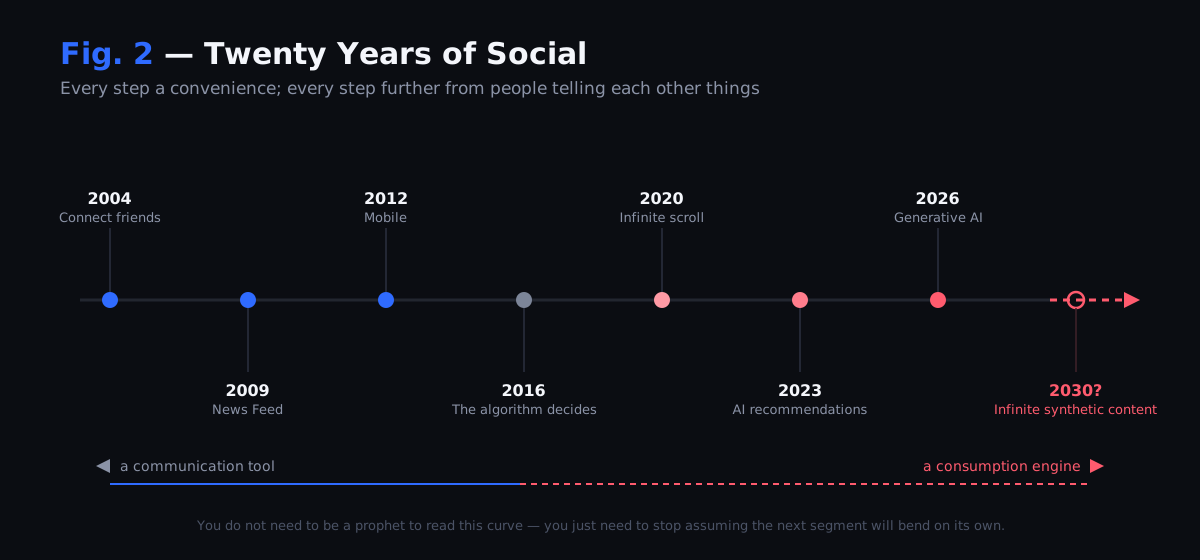
Every step was announced as a convenience. Extend the line with a ruler and see where it lands.
In 2004 the pitch was connect with your friends. In 2009 the News Feed arrived and connection became broadcast. In 2012 the smartphone put the broadcast in every pocket. By 2016 the algorithm, not your friendships, decided what you saw. By 2020 the scroll had lost its floor. By 2023 the machine was choosing not just the order of things but the things themselves. In 2026 the machine has begun making the things. Extend the line with a ruler and you arrive, somewhere around 2030, at a feed of infinite synthetic content, tuned to each of us individually, made by no one at all.
Every step was announced as a convenience. Every step was, in isolation, defensible. And every step moved the machine further from people telling each other things — which is to say, further from the reason any of us turned up in the first place. You do not need to be a prophet to read this curve. You just need to stop assuming the next segment will bend on its own.
The turn: what a race to the top looks like
Here is the thing, though — and this is where the optimist in me elbows the Eeyore aside — none of this is a law of nature. Entropy wins in closed systems. Open a system, put energy in with intent and design, and you can build cathedrals. The race to the bottom was a choice, made one quarterly earnings call at a time. A race to the top is equally available. It simply requires changing what the machine is for.
Let me sketch the design brief, because after twenty years of evidence it practically writes itself.
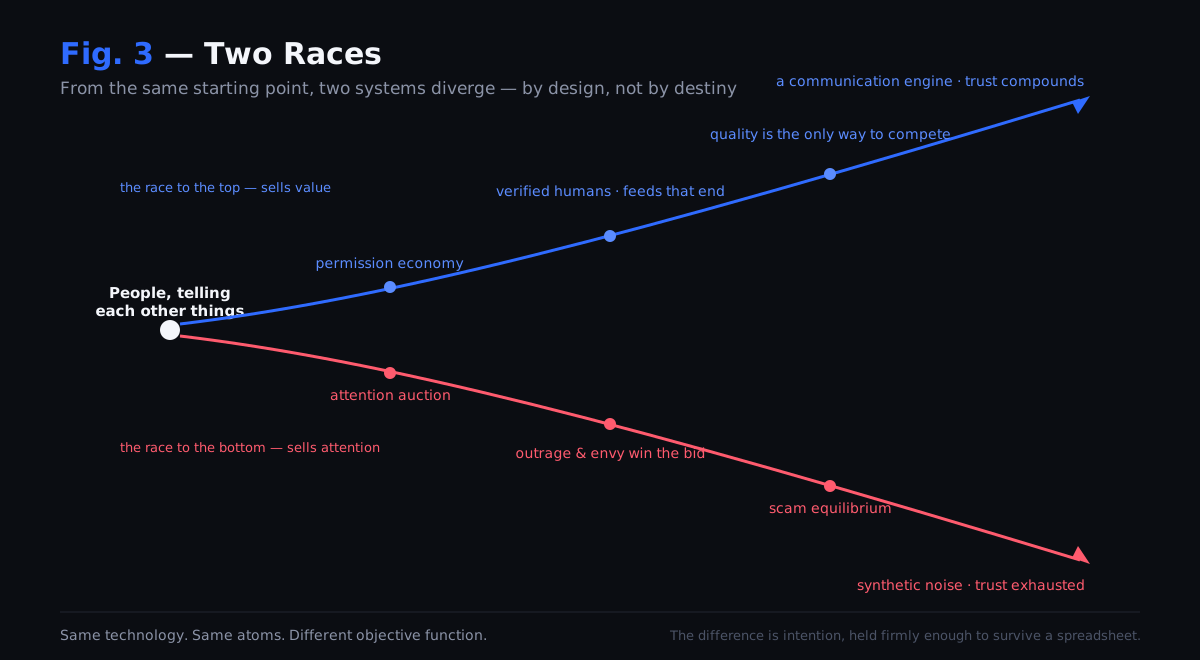
Same technology. Same atoms. Different objective function.
First, sell something other than attention. This is the root of everything. A platform whose revenue rises with scroll-time will always, eventually, build the casino — no matter how decent its people are, and many of them are very decent indeed. Sell storage, sell services, sell things with intrinsic value delivered over time, and the economic gravity reverses: suddenly there is no reason to keep anyone scrolling at 1 a.m., and every reason to make each visit worth something.
Second, let feeds end. “You’re all caught up” should not be a novelty feature; it should be the constitution. A feed that ends is a feed that respects the finite nature of a human day — and it is remarkable how much of the harm literature (sleep loss, compulsive checking, the doom-scroll itself) traces back to this single design decision.
Third, make advertising ask permission. Imagine — genuinely imagine — an advertisement that says “you’ve mentioned hiking three times; would you like to see offers on boots for the next fortnight?” and then goes away when you say no, or when the fortnight ends. Invitation instead of surveillance. The advertiser reaches someone who actually wants to hear from them — which any honest marketer will tell you is the entire point — and the scammer finds no blind auction to hide in, because every ad arrives through a door a human chose to open. Quality becomes the only way to compete. That is what a race to the top means: a market where the winning move is being genuinely useful.
Fourth, verify humanity, protect anonymity of expression, but end anonymity of reach. You may say what you like as a pseudonym among consenting adults; you may not broadcast to a million people, or buy your way into a child’s eyeline, without someone accountable standing behind the message.
Fifth, let communities govern their own commons. People weed gardens they own. They walk past gardens they don’t. Twenty years of centralised moderation has proven mostly that you cannot referee two billion people from an office in California; the alternative — small spaces, real stakes, members who can vote the rubbish out — is older than the internet and works rather better.
None of this is utopian. Every mechanism I’ve just described is buildable with entirely ordinary technology — I know this with some confidence, because I’ve spent a fair portion of my time lately building exactly these mechanisms into MiFamilias, and the hard part was never the code. The hard part is the willingness to walk away from the attention business entirely. That’s the whole trick. That’s the reboot.
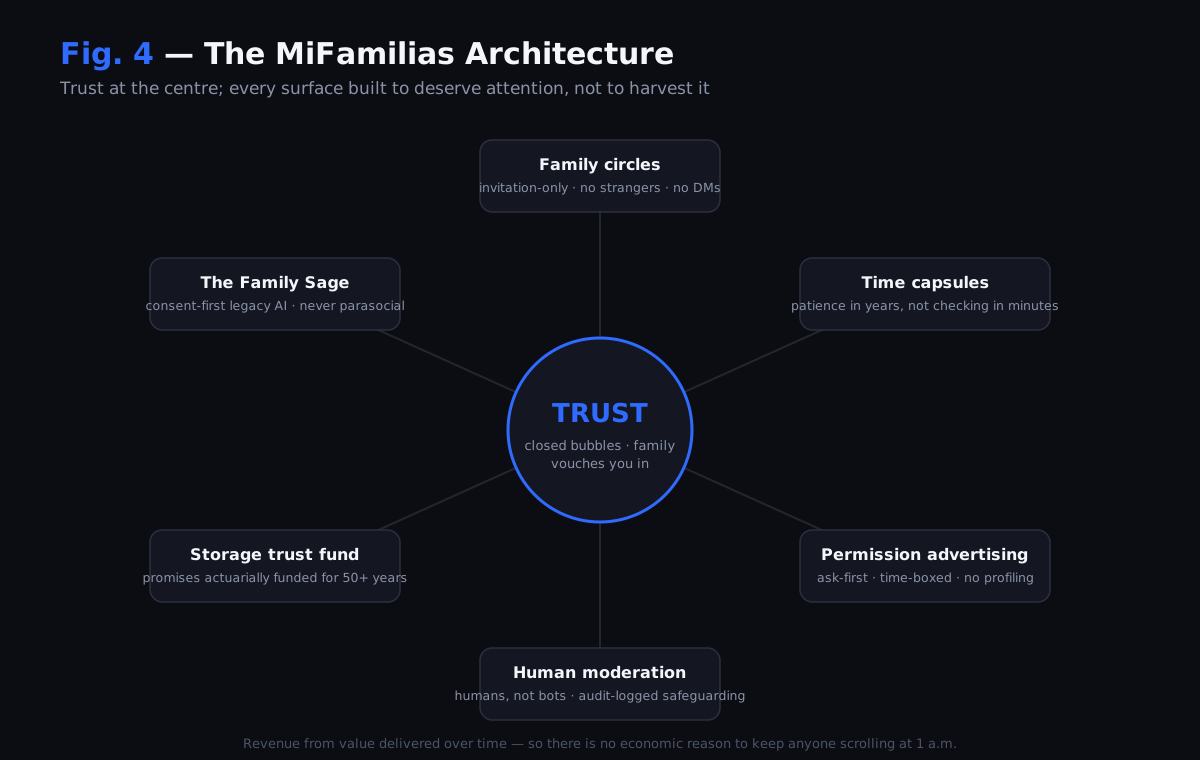
Trust at the centre; every surface built to deserve attention rather than harvest it. Revenue comes from value delivered over time — so there is no economic reason to keep anyone scrolling at 1 a.m.
Put the same design brief in the least serious form I could find, and it still holds up:
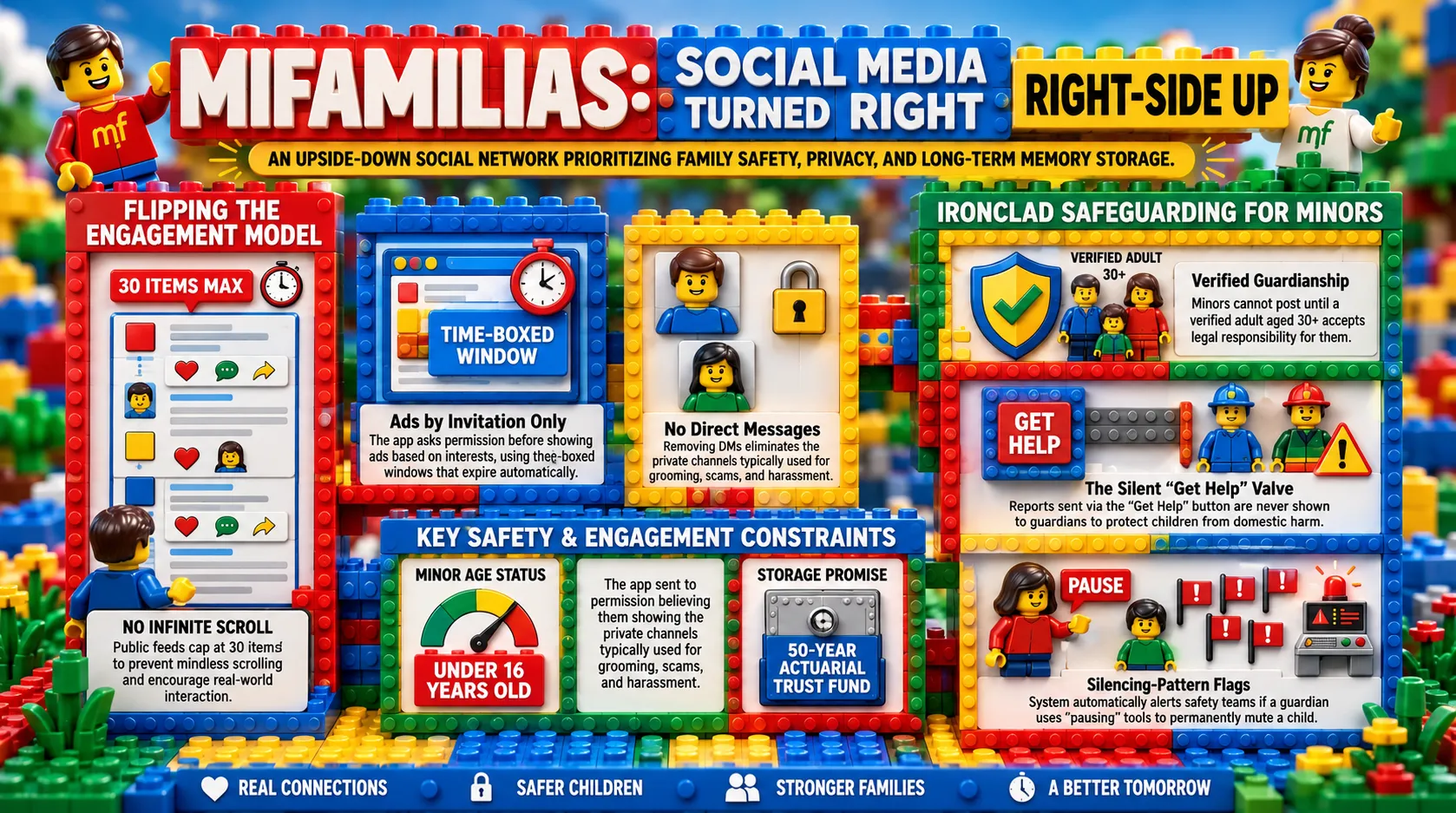
Twenty years of harm literature, rendered in plastic bricks. The embarrassing thing is how little of it is technically difficult.
Twenty years on
Here is what gives me hope, and it is not a small thing.
The first twenty years of social media were built by people who did not know what the machine would do, because nobody knew. That excuse has now expired. We have the internal documents, the longitudinal studies, the coroner’s findings, the courtroom verdicts, the regulators’ post-mortems. We know precisely which features cause which harms, the way engineers after a bridge collapse know precisely which strut failed. And in engineering, that knowledge is not a source of despair — it is the most valuable thing there is. You don’t get to build the good bridge until you understand the failure.
The universe, as I am fond of pointing out to anyone who stands still long enough, does not oblige us to build exploitative systems. It permits every configuration of matter and incentive we can imagine, and the configuration where technology helps a grandmother leave a message for a grandchild she may never meet is exactly as physically possible as the one where she is served a deepfake investment scam over breakfast. The difference between the two is not technology. It is intention, held firmly enough to survive contact with a spreadsheet.
Communication — honest, human, consequential communication — is one of the most extraordinary phenomena this corner of the universe has produced. Atoms, arranged just so, telling other atoms that they love them. That was always worth building for. It was never worth strip-mining.
Twenty years on, the reboot isn’t a dream. It’s a to-do list. And some of us have already started ticking.
The first twenty years of social media taught us how to maximise attention.
The next twenty should teach us how to deserve it.
The working, in full
Two documents sit underneath this essay. The first is the evidence base — every source located by live research, tagged by verification status, with the harm literature, the null-effects literature and the methodological critiques of both represented in full, because a compendium that only collects the findings you like isn’t a compendium. The second is what you do about it: the design paper that takes each documented harm pathway in turn and shows the mechanism that removes it.
Sources for the figures cited: Reuters’ reporting on internal Meta documents (December 2025) as covered by Fortune/Yahoo Finance and AML Intelligence; the February 2026 consumer-organisation open letter to Meta. The design-feature evidence base is set out in full in the two papers above. The story of how MiFamilias started is here.